Showing posts with label Bird Flu. Show all posts

Thursday, January 09, 2014

First North American Bird Flu Death Of 2014

From ABCNews
The first person to die of the deadly H5N1 avian flu virus in North America had just returned from China, Canadian authorities have confirmed.

Officials said the victim, whose gender and other details were withheld to protect the family's privacy, had recently returned from a trip to Beijing.

He or she died in Canada's western plains province of Alberta.

Canada's health minister Rona Ambrose said it was the first known instance of someone in North America contracting the virus and stressed it was an "isolated case".

"I want to reassure the public this is an isolated case and the risk of H5N1 to Canadians is very low," Ms Ambrose said.

Full Story Here

Sunday, April 07, 2013

H7N9 Bird Flu Begins Killing People In China

Here we go again?

From the Daily Mail:
A deadly strain of bird flu previously unknown in people has begun to mutate into a form more likely to cause a human pandemic, scientists say.
Just days after authorities in China announced they had identified cases of H7N9, flu experts in laboratories across the world are picking through the DNA sequence data of samples isolated from patients to assess its severity.

One of the world’s top flu experts, Ab Osterhaus, from the Erasmus Medical Centre in The Netherlands, says the sequences show some genetic mutations that should put authorities on alert and entail increased surveillance in animals and humans.

'The virus has to a certain extent already adapted to mammalian species and to humans."

The Full Story Is Here 

Monday, April 02, 2007

Bird Flu Virus Continues To Spread Across The Planet

China, Indonesia Report New H5N1 Deaths, Infections


The past week has seen a sharp increase not only in the number of countries reporting new H5N1 infections in poultry birds, but also human infections and deaths.

This will not be a completely comprehensive round-up of the latest news, just what I believe are the main and most important cases. While new outbreaks and deaths are being reported by the mainstream media, few are putting all the new together in the same story. By spreading the news out across small articles on different days, the full impact of this alarming increase of new infections and deaths is diminished.

For example, two more people have died of bird flu in Indonesia, but three died last week. That means Indonesia reported five human deaths in less than nine days, and reported a spate of new human infections, including the infection of a doctor who was treating a boy who died.

The World Health Organisation is growing extremely concerned, as are the governments of China, Bangladesh, Indonesia, Russia and the EU. Indonesia now regards the virus as endemic across the peninsular, but there is a mounting sense of panic amongst bird flu experts as nothing done is being seen as halting the spread of the virus, or stopping new human infections.

At the same time, the 'miracle' drug Tamiflu is not living up to expectations. The anti-viral is being given to people infected with the virus, but more are dying than surviving. Some of the countries with the highest infection rates are now looking at using double-doses of Tamiflu.

Comparing the number of human infections that resulted in the victims dying, the fatality rate for humans infected with the virus in Thailand, Indonesia and Egypt now sits above 69%.

The H5N1 virus is spreading, it's spreading fast and it appears to be growing more lethal.

INDONESIA : A 22 year old woman and a 28 year old man have died from the virus, the government reported yesterday. A doctor who treated one of the three victims who died last week was hospitalised himself after becoming infected with the virus. Indonesian scientists have admitted they are "baffled" by the random nature of new outbreaks and infections, as they are not able to detect a pattern to the spread of the virus.

BANGLADESH
: The H5N1 virus has spread to five more poultry farms in the past week. Sixteen farms have now reported infections. More than 60,000 birds have been culled.

CHINA : A 16 year old boy was reported to have died from the virus yesterday. He was hospitalised on March 20 and died seven days later. The Chinese government remains tight-lipped about how many regions are reporting infections. A second person is reported to have died, but no details have yet been released.

EGYPT : Three children under eight years old have been hospitalised after falling ill with H5N1, all three are being treated with Tamiflu. All three are believed to have caught the virus from poultry birds. The virus was first found in Egypt in February 2006. Since then more than 30 people have caught the virus, killing 13.

KUWAIT : The government is culling more another 1.1 million poultry birds to stop the spread of the H5N1 virus. More than 1.5 poultry birds have already been culled. The culls have devastated Kuwait's egg production, with more than 60% of layer birds now destroyed. Kuwait has shut down it's only zoo, has closed live bird markets and closed hundreds of shops that sold poultry birds. Bird imports and exports are now also under a ban. The government claims there are no human infections. The virus was first reported in Kuwait in late 2005.

VIETNAM : Only days after claiming the spread of the virus was contained, the government has reported two more duck farms have become infected. Vietnam was hailed by the World Health Organisation as a prime example of how the virus can be contained when the virus was believed to have been eradicated in 2005. Vietnam went a year without any new outbreaks.

Sunday, January 28, 2007

Buy More Tamiflu

US Senate Told Americans Are Ignorant Of Bird Flu Threat


The threat of a bird flu pandemic breaking out amongst human populations has been very, very good for the makers and distributors of Tamiflu, a drug widely popularised as being an effective treatment for stopping the virus from overwhelming the sick once infected with H5N1.

Literally, billions of dollars worth of orders for Tamiflu stockpiles were placed after a brief panic over a bird flu pandemic swept most of the world in late 2005 and early 2006. Australia alone placed orders said to be worth close to $400 million.

But sales for Tamiflu are dropping off, and the threat of a bird flu pandemic remain as realistic as they were two years ago.

The US Senate is now being warned that Americans are ignorant about the threat of bird flu, and the need for hospitals and health centres to stockpile more anti-virals. Like Tamiflu.

From Reuters :

Bird flu poses as big a threat to the world as ever, and people need to worry about it more, U.S. senators and health leaders agreed on Wednesday.

Gerberding said a delay in passing 2007 spending bills has hurt efforts to prepare. Congress is currently funding the agencies through what are known as continuing resolutions, not permanent budget commitments.

The H5N1 avian flu virus could cause a human pandemic at any time, killing perhaps millions, yet preparations are slow, they told a Senate hearing.

"I am concerned that there is not as much public awareness or concern today as there was a year ago," Pennsylvania Republican Sen. Arlen Specter told the hearing of the Senate Appropriations subcommittee on health.

"You don't want to unduly alarm people. (But) I think people are unconcerned."

"People who fail to prepare for a flu pandemic are going to be tragically mistaken," Dr. Julie Gerberding, director of the U.S. Centers for Disease Control and Prevention, told the hearing.

"It is inevitable," she added. "I don't know when and I don't know which virus will be the culprit."

"It's moving biologically," Gerberding said. "It's mutating and evolving."

Health experts want more people to get seasonal influenza vaccines, both to protect themselves and encourage more companies to make flu vaccine. Roche and Co.

ROG.VX, which makes the flu drug Tamiflu, said on Wednesday only 29 U.S. states had ordered Tamiflu so far and few had ordered their full allocation.

But the company said it had sold the drug to more than 300 companies and increased its global production capacity for Tamiflu 10-fold to 400 million treatment courses annually

How many other American products can be claimed to have seen a ten-fold rise in production in the past two years?

Thursday, January 25, 2007

Drowning On Your Own Blood

Recreating The 1918 Bird Flu Virus That Killed 60 Million People Reveals Ways To Fight Our Future Pandemic


After numerous books and movies, and television shows, depicting the aftermath of a letahl virus escaping from a bioresearch lab, it must be near impossible for scientists and researchers to to not think about, and perhaps joke about, how they would feel if the lehal virus they were working on somehow escaped from their lab.

I don't mean to be flippant about the importance of such research, or killer viruses, but many of these researchers and scientists must have read some of the fiction, such as Stephen King's 'The Stand' and watched some of the movies that depict such scenarios, if only to debunk them.

"Look at that. We'd never do that in our lab. Did they actually have someone who knows what they're doing to advise on making that lab scene authentic?"

I only raise this because it was exactly the first thing that crossed my mind when I read the following stories, excerpted below.

Because the researchers in the story aren't just working on any one of the numerous lethal viruses and baterium that fill research labs around the world today.

They had recreated The Big One. .The 1918-1919 Bird Flu pandemic virus, otherwise known as Spanish Flu, which killed 40 to 60 million people around the world in less than nine months.

Consider that World War 1 lasted for four years, had battles where 20,000 men died in one morning, and less people died during that War then died the year after it was over.

What these researchers witnessed must have chilled them to the bone. The full fury of human history's most lethal virus, and it was under their control.

So just how tight is that lab security anyway?

From the BBC :

Scientists who recreated "Spanish flu" - the 1918 virus which killed up to 50m people - have witnessed its remarkable killing power first hand.

The lungs of infected monkeys were destroyed in just days as their immune systems went into overdrive after a Canadian laboratory rebuilt the virus.

...the results were startling. Symptoms appeared within 24 hours of exposure to the virus, and the subsequent destruction of lung tissue was so widespread that, had the monkeys not been killed a few days later, they would literally have drowned in their own blood.

The results match those seen when mice were infected in an earlier study and are very similar to those described in human patients at the time the virus was at its height.

Darwyn Kobasa, a research scientist with the Public Health Agency of Canada, and lead author of the research, defended the decision to recreate one of the most dangerous viruses in history.

He said: "This research provides an important piece in the puzzle of the 1918 virus, helping us to better understand influenza viruses and their potential to cause pandemics."

However, it is not the virus that is directly causing the damage to the lungs - it is the body's own response to infection.

Immune system proteins that can damage infected tissue were found at much higher levels following H1N1 infection compared with other viral infections.

Analysis at the University of Wisconsin at Madison (UW) revealed that a key component of the immune system, a gene called RIG-1 appeared to be involved.

Levels of the protein produced by the gene were lower in tissue infected with the 1918 virus, suggesting it had a method of switching it off, causing immune defences to run wild.

This ability to alter the body's immune response is shared with the most recent candidate for mutation into a pandemic strain, the H5N1 avian flu.

Experts are worried that if the virus changes so that it can infect humans easily, it could again be far more lethal than normal seasonal flu.

Dr Ronald Cutler, an infectious diseases researcher at the University of East London, said: "Knowing how that over stimulation takes place could lead to the development of new methods to treat these diseases so we are better prepared for any future pandemic."

Indonesia Prepares For Mass Poultry, Bird Cull To Halt Spread Of H5N1 Virus

Live Birds Seen Flying Out Of Poultry Bonfires

Indonesia is not, officially, suffering from a bird flu pandemic in its poultry, but few now argue against the fact that an epidemic of the virus is raging across dozens of towns and villages, on numerous islands in the archipelago.

Indonesia's attempts to halt the spread of avian influenza has failed simply because poultry is such a vital part of Indonesians daily diet, and because many Indonesians keep poultry in their yards, running loose.

At least 30 million Indonesians households are reported to have at least one poultry bird in their yard, or more rarely, in a pen or a box.

They don't need to be fed, unless the trees in the yards, or the grass, are bare and produce nothing from which the poultry can forage.

And then there is the fact that Indonesia is a huge archipelago of hundreds of islands.

When families travel from one island to another on ferries or small boats for feasts and celebrations, many bring poultry birds with them. This practice alone helps to spread the virus amongst poultry birds.

But Indonesian is caving in to World Health Organisation and United Nations pressure to ramp up their poultry culling programs.

It's going to be an enormous task, and the cullers sent out to destroy poultry stocks in areas of past outbreaks have met aggressive resistance from the locals, who see no reason why their food supply should be destroyed.

There is a program of compensation payments for the poultry birds destroyed, but it is almost impossible to keep free from corruption, and there is enormous confusion.

A villager may get $1.70 for a chicken they hand over, but the are not compensated for the eggs the chicken would have produced in the year or to ahead. Nor are they compensated for the offspring this chicken would have likely produced.

To many rural Indonesians, this single payment for only the one poultry bird they hand over leaves them feeling cheated.

Indonesia has already invested tens of millions of dollars in advertising and awareness campaigns to inform the widely spread population not only of the dangers of avian influenza, but also that they soon unlikely to be allowed to keep poultry in the yards of their homes.

The Indonesia government also has to counter the deeply grounded belief that there is no such thing as avian influenza, and the talk of 'bird flu' is just a way of making them go to shops and supermarkets to buy chicken and eggs.

Nevertheless, Indonesia is now set to begin the biggest poultry and bird cull they've yet attempted.

And there is no guarantee that this venture will stop the avian influenza virus from spreading.

But Indonesia has no choice. If they are to keep on recieving WHO and UN funding for programs to tackle bird flu, they have to follow the mandated rules.

And the chief rule is : cull poultry and stop people from living amongst poultry birds.

From ABC's AM :
The World Health Organisation has labelled Indonesia's bird flu epidemic uncontrollable.

Bird flu has already killed five people in Indonesia this year. Now the country is about to embark on an unprecedented campaign of mass culling.

In Jakarta next week residents will be forced to hand over their backyard poultry...

Enforcing Jakarta's new ban on backyard birds is a messy and often confusing business.

Door to door go local officials, yanking birds from their cages with varying degrees of compliance from their owners.

Almost 1.5 million chickens, ducks, pigeons and other birds live with or alongside people in the Indonesian capital.

Until next Thursday, the bird-owners have been asked to comply with the ban voluntarily...

Tens of thousands of birds are sometimes being gathered at public events where people come and to eat free, safely cooked chicken, while officials give speeches and light bonfires of slaughtered poultry, all the name of spreading awareness of avian influenza.

Edi Santoso is South Jakarta's Head of Animal Husbandry and Fisheries :
Yeah, we hope that people voluntarily give up their birds and give it to us so next time we don't have birds in the neighbourhood.
It can be a haphazard and brutal display. Their throats slit, the birds are often still flapping as they are thrown into pits. Some even fly out on fire, and others escape altogether.

As the above report stated, the culling program is now unfolding under voluntary guidelines. The enforcement of the cull, where Indonesian police or Army go house to house to kill every poultry bird they find, will face even greater resistance, and aggression.

The psychological impact of these collection and culling programs is yet to be assessed. But it is likely to show high levels of resentment and dysfunction.

The WHO and the UN are basically asking Indonesians to change in the most fundamnetal ways a vital and important part of their culture : the keeping, raising and eating of their own poultry.

Wednesday, January 17, 2007

Bird Flu Hits Japan, China, Hong Kong, Vietnam, Thailand - More Deaths In Indonesia

Googling the words "bird flu" through Google News sometimes only pulls up a few stories about how various countries, and cities, are working through pandemic preparedness programs, or you find ten variations on a new warning from the World Health Organisation that a worldwide pandemic could kill 60 million, 100 million or 200 million.

But some days, like today, the computer screen jolts you like an electric shock. A storm of new outbreaks, more deaths, more dire warnings unfold in front of your eyes. It's not if, but when the pandemic hits, the experts say, and you wonder, again, is the week it begins?

Will this be the week in which historians, those who survive anyway, will look back and say, "That was the week we learned there was no turning it back. The pandemic had begun."

It's an alarming list of news stories that doesn't bode well for 2007 :

Indonesia : Mother, Son Die Within Days Of Each Other - Reality Of New Virus Clusters Come Into Focus

China Urges Unity Across Asia To Fight Spread Of Avian Influenza

4000 Chickens Died Last Week Of H5N1 Infection In Japan's Largest Poultry Growing Region

Ducks, Pigeons Die Suddenly From Bird Flu As Virus Hits Thailand

Indonesia Set To Ban Backyard Poultry In Renewed Fight Against Spread Of Bird Flu

Vietnam : Bird Flu Virus Discovered In Four Provinces In Past Ten Days

Indonesia : Four Dead From Bird Flu Virus This Year, Hospitals Prepare For More Human Outbreaks

Reports Of Bird Flu Outbreaks Spreading Across Asia


Bird Flu Pandemica Poses Grave Threats To Global Markets - Impacts Predicted To Be Worse Than Terror Attacks


Bird Flu Speads In Asia, Jump Seen In Indonesian Cases

Saturday, December 09, 2006

ANNUAL FLU PANDEMIC WARNING FOR HAJ PILGRIMAGE GENERATES CALLS FOR MASS VACCINATIONS

EXPERTS SAY BIRD FLU VIRUS IS STILL "SMOULDERING"


It's time once again for the Hajj pilgrimage in Saudi Arabia, so that means the now standard annual warning of a possible flu pandemic breaking out amongst the millions of Muslim worshippers is being sounded.

The difference this year is the rising call for worshippers to be vaccinated before they arrive in Saudi Arabia. Not only is the call being promoted as a necessity, but some experts are demanding the vaccinations become mandatory.

From The Australian :

Experts have now urged flu vaccination to be made mandatory for worshippers embarking on the pilgrimage, a trip expected of every Muslim who can afford it at least once in their lifetime.

The next Hajj starts on 28 December and lasts for seven days. Between two and three million pilgrims from all over the world are expected to descend on Mecca and other holy sites, staying in extremely crowded conditions.

In terms of public health, “such a gathering makes the possible rampant spread of the influenza virus and a global pandemic... a potentially devastating prospect”, say experts writing in the latest British Medical Journal.

The authors said the crush of people meant it was “not unusual for 50-100 people to share a tent overnight” in desert camps, a degree of overcrowding that “greatly increases the spread of respiratory infections”.

They added the World Health Organisation “must work with the Saudi authorities to minimise the risk of the influenza virus spreading among pilgrims (and the rest of us)”.

Australian flu expert Alan Hampson - a member of the WHO's Pandemic Taskforce set up to counter a global flu outbreak - agreed the risk was real.

“If we were unfortunate enough to see the start of an avian flu outbreak during the Hajj, there's no doubt that would be a great way to spread it to other people quickly, and then spread it around the world when they return home,” he said.

As far as the possibility of a bird flu pandemic breaking out amongst worshippers on the Hajj, experts remain divided whether existing vacinnations would be of any use, as they will not be tailored to fight a virus that has not yet fully shown itself.


While dire predictions late last year and earlier this year about the likelihood of a human bird flu pandemic becoming a reality have proven to be misplaced, avian influenza virus experts are warning the threat is not yet over. While Indonesia is, officially, still clocking up three or four human deaths per month from avian influenza, there have been no more than a handful of deaths elsewhere in the world.

However, experts agree that this does not mean it is time to become complacent about the possible devastating outbreak of a bird flu pandemic amongst humans.

The virus may have gone quiet in recent months, but some experts fear this is because the virus is now "smouldering"; not yet extinguished, and ready to burst back into the human population.

From CNN :
A year ago, headlines were screaming about a looming disaster: the rapid spread of bird flu across two-thirds of the globe. The H5N1 strain of the virus was killing more than half its human victims. Experts were urging the government to stockpile medicine and experimental vaccines.

Dr. Robert Webster, whose vaccine the U.S. government plans to use in case of an outbreak, told CNN at the time, "If this virus learns to transmit human to human and maintains that level of killing, we've got a global catastrophe."

That worldwide pandemic hasn't yet materialized, and bird flu has been out of the headlines for a while. But we may be in for another round of news.

Last week South Korea announced two new outbreaks in poultry.

...Dr. Timothy Uyeki of the U.S. Centers for Disease Control and Prevention said he's bracing for another surge in human infections.

Three recent papers in the New England Journal of Medicine illustrate serious roadblocks to understanding and controlling the virus. The first describes three clusters of cases within families in Indonesia, eight patients in all. In two of the clusters, the authors said it's quite possible one person caught the disease, then passed it to family members.

One of those families was profiled in "Killer Flu," a CNN program last December. Rini Dina, a 37-year-old woman in a Jakarta suburb, died of an H5N1 infection, and her 8-year-old nephew, Firdaus, was hospitalized with fever for 10 days.

Worldwide, about a third of all cases involve family clusters and there are a handful of cases where the virus likely passed from person to person, he said.

As a clinician, Uyeki has also helped to examine bird flu patients in Indonesia and Vietnam, the only U.S. doctor to do so.

As the virus evolves, he said, its symptoms are evolving as well.

"The clinical features in 1997 were different than what they are now. We're seeing less diarrhea, and in Indonesia, it's been much more fatal."

Other, more common symptoms are hard to distinguish from other infections -- fever, aches and coughing, and shortness of breath and pneumonia as the illness progresses.

In a commentary published with the two articles, Webster and another prominent flu expert said efforts to eradicate the virus, through killing infected chicken flocks or by vaccinating poultry, have largely failed.

Worse, they said, many vaccines used in Asia are of poor quality and are pushing the virus to mutate faster, in potentially more dangerous directions.

Go Here For The Full Story


Donors Pledge Nearly $500 Million More To Battle Bird Flu

Chicken Traditions Expose Africans To Bird Flu

Bird Flu Only Tip Of The Iceberg When It Comes To Deadly Diseases That Threaten Humans, Animals


Global Warming, Intensive Farming, Fast Travel Allow Easier Transmission, Growth And Spread Of Killer Viruses

Bird Flu Specialists Focus On Africa & Asia

For American Media, Bird Flu Appears To Have Flown The Coup

World Health Organisation Claims Bird Flu Vaccine Could Be Available Within Twelve Months


Researchers Claim To Have Found Bird Flu Virus' "Weak Spot"

Swiss Claim Success In Vaccinating Birds In Zoos

Thursday, November 30, 2006

THE RETURN OF THE SPANISH FLU

HOW 'THE BIG THAW' COULD BRING BACK THE 1918 BIRD FLU VIRUS THAT KILLED 40 MILLION

It's only a theory for now, but it reads like something out of a nightmarish horror novel nobody has yet written (as far as I can research online). So what happens if the 1918 bird flu virus comes into contact with today's H5N1 strain? Do they cancel each other out? Or do they recombinate to deliver us the long-feared second global pandemic in 100 years?

From Bloomberg :
Influenza viruses may be preserved in glaciers and Arctic ice for thousands of years and released into the environment when the frozen water is thawed, potentially touching off lethal pandemics, researchers said.

Global warming may speed the release of the microbes, increasing the frequency of outbreaks, according to a study in the December issue of the Journal of Virology.

The study is based on tests of water and ice from three lakes in Siberia, where large populations of migratory waterfowl breed before traveling to North America, southern Asia, Europe and Africa.

The finding may help explain the constant emergence of influenza A-type viruses that cause seasonal epidemics and occasionally set off pandemics capable of killing millions of people. Disease trackers are monitoring flu viruses amid an outbreak of the H5N1 strain, known to have infected 258 people in 10 countries in the past three years, killing 153 of them.

The spread of H5N1 in late 2003 has put the world closer to another pandemic than at any time since 1968, when the last of the previous century's three major outbreaks occurred, according to the World Health Organization.

Many species of aquatic birds flock to Siberia and other areas near the Arctic Circle for breeding during the Northern Hemisphere's summer before flying south during the fall.

As the birds visit lakes along their paths they shed viruses into the water and onto any ice present, and drink water containing viruses discharged by other birds or released from the ice by thawing, the authors said in the study.

In previous studies, the authors, who include researchers from Israel's Bar-Illan University and the Russian Academy of Sciences, documented the preservation of viruses, bacteria, and fungi in glacial ice for as long as 140,000 years.

Surveillance of Arctic lakes may help disease trackers predict which flu strains will cause future outbreaks and shape long-term vaccination strategies, the researchers said.

Until refreezing takes place, viruses of both present and past strains may be contracted by the waterfowl, allowing old and new viruses to continually recombine, the study said.

Tuesday, November 28, 2006

VERMONT PREPARES FOR WORST-CASE BIRD FLU PANDEMIC

PANDEMIC PREPERATIONS TO DOUBLE AS TERROR ATTACK RESPONSE PLAN


From the Boston Globe :

If a much-feared worldwide pandemic flu hits Vermont with all its fury, public gatherings could be banned and schools closed. Hospital wards would be set up in tents or gymnasiums. Flu medications would be parceled out, and nonessential medical care suspended.

The number of dead could overwhelm the state's medical examiners and morgues, forcing the state to rent refrigerated trailers to store bodies.

In the end, Vermonters would have to ride out a worst-case pandemic flu outbreak, which could come in waves and last a couple of months. By the time it was over, more than 3,000 people would be dead. Normally about 5,200 people die in Vermont every year.

That's the worst-case scenario state health and emergency preparedness officials are planning for.

In preparing for avian flu, health officials look to the worldwide flu pandemic of 1918 that killed millions. In Vermont an estimated 23,000 people were sickened and 1,800 died.

"The hysteria is justified," said Cote.

But public health officials learned a lot from the 1918 pandemic . For instance, that flu was spread at large public gatherings such as parades, Cote said.

Over the last two years, Vermont has spent more than $2 million in federal grants and state appropriations to prepare for the flu.

There have been numerous exercises involving scores of officials from dozens of communities and agencies; there have been planning sessions, and Vermont is working with other states to coordinate responses to a pandemic. There have been mock vaccination clinics, and Vermont is acquiring 300,000 protective masks for health care workers and 65,000 doses of Tamiflu, a drug that reduces the length and severity of flu symptoms.

Even if a flu pandemic never occurs, preparations under way could be used for other health emergencies, a terrorist attack, or other potential hardships , Cote said
SOUTH KOREAN BIRD FLU OUTBREAK SPREADS FAST

MASSIVE CULL OF PIGS, DOGS AND CATS CONSIDERED TO CONTAIN SPREAD OF VIRUS
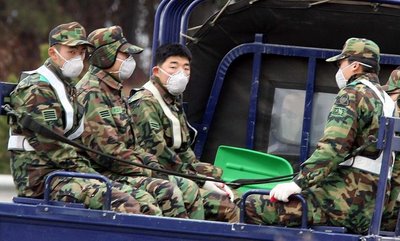


The current outbreak of the bird flu virus amongst poultry in South Korea provides a good example of just how fast panic over the virus can spread, how fast it can kill, how quickly a government can move to deal with the outbreak, after initially denying it, and how rapidly bizarre containment measures can become a disturbing reality.

On Friday, November 24, the first stories began to appear detailing what an outbreak of what was deemed to be a "low-grade" version of the avian influenza virus.

This from The Star :

A low-grade strain of bird flu has killed 200 chickens south of the South Korean capital, the agriculture ministry said Friday.

The ministry identified the strain of bird flu as "low pathogenic'' and said that it was neither the H5N1, which can be lethal to humans, nor the less dangerous H5N2 strains.

The ministry said it would take preventive measures, including disinfecting the remaining 19,000 chickens at a chicken farm in Pyeongtaek city, about 65 kilometers (40 miles) south of Seoul.

Around 6,000 chickens have died there, prompting authorities to cull a further 6,000 to prevent the possible virus from spreading, said the ministry, adding that it could confirm this weekend whether it was the H5N1 strain.

South Korea culled 5.3 million birds during the last known outbreak of bird flu in 2003. The H5N1 virus began ravaging Asian poultry stocks in late 2003 and has killed at least 153 people worldwide.

The next day, the financial media had picked up on the story, and the facts were quite different. Not only was the South Korean outbreak confirmed as as the H5N1 strain, it had now become "highly pathogenic", and this revelation came from the same SK agriculture ministry that said less than 24 hours before that the outbreak was of a low pathogenicicty.

From Bloomberg.com :
A highly pathogenic strain of the H5N1 bird flu was responsible for the deaths of 6,000 poultry on a South Korean farm, the nation's agriculture ministry said. It ordered the slaughter of 236,000 nearby animals to stem the spread of the disease.

The farm in the southwestern town of Iksan had housed 13,000 head of poultry. Almost half of the brood died since Nov. 19, the Seoul-based agriculture ministry said in a statement today. All animals within 500 meters (1,640 feet) of the farm will be culled, it said.

"The H5N1 strain was verified as highly pathogenic,'' the ministry said.

The difference between "highly pathogenic" and "low pathogenic" is fairly straightforward, and explains how easy it can be to miss a strain that begins with a low pathogenicity and can quickly evolve into the far more deadly high pathogenic strain.

Low pathogenic bird flu virus is said to cause only mild symptons in poultry stocks. Egg production may drop off slightly, or the birds could look a little mangy, feathers unusually ruffled. Such mild changes in egg laying or the physical appearance of the poultry can be easy to miss on farms which hold, literally, hundreds of thousands of chickens or fowl.

But high pathogenic bird flu virus, according to the World Health Organisation's own website, is far easier to recognise.

Within 48 of infection, the birds become clearly ill, as the virus destroys internal organs, and it spreads rapidly. The World Health Organisation now talks about 100% mortality rate for poultry. Which means if all the poultry on an infected farm are not culled, it is very likely they will all die, regardless, and this could hasten the spread of the virus to areas outside the infected farm.


By Monday, November 27, the situation in South Korea had become absolutely dire. Hong Kong and Japan had banned all poultry imports from South Korea, more than 125,000 poultry birds had been slaughtered, and a cull of all poultry within 500 metres of the infected farm was underway. 240,000 poultry birds are estimated to be culled within the next few days, and some 6 million eggs will also be destroyed.

But the South Korean agriculture ministry also announced it was planning to cull dogs, cats and pigs.

From Medical News Today :
Officials did not say how many dogs, cats and pigs will be culled. Outside Korea, the only place other animals, apart from birds, that have been destroyed has been Indonesia, where pigs were killed to stem the spread of bird flu. In 2003/2004 South Korea destroyed 5.3 million birds and an unspecified number of cats and dogs.

Other countries do slaughter cats and dogs, they just don't admit to it, say South Korean officials. Peter Roeder, Food and Agricultural Organization, Rome, Italy, told the Associated Press the measure is highly unusual and not a science-based decision.

By Tuesday morning, November 28, the London Times claimed the slaughter of dogs in South Korea was about to begin :

Health officials in the town of Iksan, 250km (155 miles) south of the capital, Seoul, intend to kill 577 dogs and an unspecified number of cats after an outbreak of the H5N1 strain of avian influenza among farm chickens.

Some health experts believe that the killing of dogs and cats is unnecessary and will not impede the disease. “It is highly unusual, and it is not a science-based decision,” said Peter Roeder, of the United Nations Food and Agricultural Organisation. “We’ve got absolutely no reason to believe they are important.”

“Other countries do it,” said Kim Chang Sup, of the South Korean Health Ministry. “They just don’t talk about it. All mammals are potentially subject to the virus and South Korea is just trying to take all possible precautionary measures.”

Tuesday, November 21, 2006

TOP BRITISH SCIENTISTS SHRED GOVERNMENT'S PLANS FOR PANDEMIC- READY STOCKPILES OF VACCINE AND ANTI-FLU DRUGS

From the UK Guardian :
Some of Britain's top scientists yesterday accused the government of failing to listen to expert advice in its preparations for a flu pandemic and of stockpiling a single drug, which might not work, to treat the population.

Over 14m doses of the drug, Tamiflu, have been delivered, but two leading scientific institutions, the Royal Society and the Academy of Medical Sciences, say the government should be buying similar quantities of a second drug, Relenza, as well.

Reports from south-east Asia suggest that in a few cases Tamiflu has not been effective because the H5N1 bird flu virus, which has proved lethal to humans, has developed resistance to the drug.

The order of 14.6m courses of Tamiflu was completed in September and is intended to be enough to treat 25% of the population. But even if Tamiflu works against H5N1, it may need to be given in larger doses than originally intended and there will be no time to manufacture more between waves of the pandemic, so the stockpiles of both Tamiflu and Relenza may need to be larger than at present, the report says.

Tamiflu attracted further controversy last week when it was linked to suicidal feelings among some young people.

A 10-month review by the US drug regulation body, the food and drug administration, identified 103 incidents where young people on the drug had demonstrated disturbed behaviour, including a 17-year-old youth who jumped in front of a truck and a 14-year-old boy who died when he fell after climbing on a balcony railing.
Go Here To Read The Full Story